
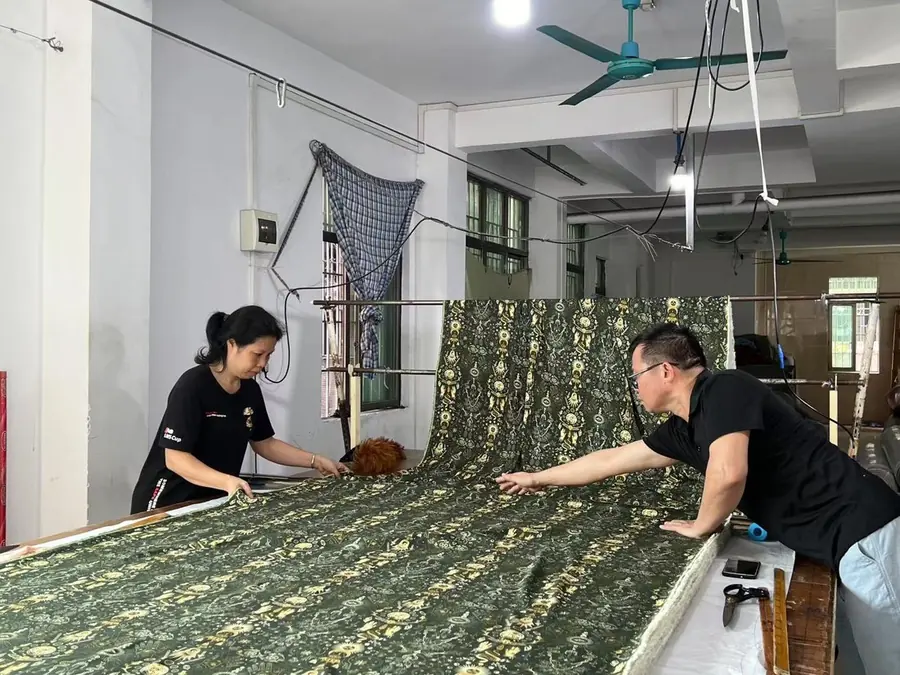
Approving a print colour does not also approve its scale or position. Keep fabric artwork approval separate from the checks that depend on cutting, sewing and the finished garment size.
Specify the result before choosing a print process
State whether the style uses a repeating fabric design, a motif at a defined garment position, or both. An all-over repeat can look consistent without placing the same flower in the same spot on every garment. If that exact location matters, include it as a requirement for the supplier to review.
Provide the proposed fabric, artwork version, colourways and style reference. Ask the supplier to confirm the file requirements and a feasible production route for that combination. A printing platform's accepted file format or positioning allowance is specific to its service; it should not become the default specification for a different factory.
If the fabric brief is incomplete, use the sleepwear fabric specification checklist before treating the artwork as ready for production.
Record motif size and repeat size separately
Give the intended width and height of the repeat unit in a stated physical unit. Also measure one identifiable motif within it. These two references let the buyer and supplier check both the overall layout and the scale of an individual element without relying on screen zoom.
Provide a preview showing several repeats in both directions. Look for gaps, broken shapes or unexpected bands where the units meet. If rows or columns are offset, show that arrangement explicitly rather than leaving the supplier to infer it from a single tile.
Decide whether motif scale remains constant across the size range. If different sizes require different artwork dimensions, list them and identify the files that apply. A larger garment size should not trigger an unrecorded artwork change.
Mark direction and placement on the garment
Use arrows to show the intended orientation of directional motifs on the front, back, sleeves, pockets and trouser legs. State where rotation is acceptable, subject to the fabric and construction requirements. Review the top and trousers as separate components of the same set.
For a placed graphic, provide its dimensions and a measurement reference on the finished garment, such as a specified seam or edge. Identify the sample size, how the position applies to other sizes and the agreed measurement method. A floating graphic on a mockup does not supply those instructions.
Make seam matching a specific discussion
Mark each area where continuity matters: for example, a patch pocket over the front panel or stripes across the closed front opening. Show which lines or motifs should meet and how the garment will be positioned for inspection. Avoid an undefined instruction to match the print everywhere.
Ask the factory to assess the proposed matching requirement before confirming price or sample scope. Agree the locations, acceptable variation and review method against the actual style. If the requested effect cannot be produced consistently, revise the design or approval requirement before treating the mockup as a commitment.
Use physical proofs for the decisions a screen cannot settle
Digital artwork review helps identify repeat faults and file issues. A physical print proof lets you assess the printed appearance on material. Spoonflower's proofing guidance makes this distinction and notes that larger designs may need more fabric than a small swatch to be reviewed properly.
Request a proof that corresponds to the proposed fabric and print method. It should show enough of the design and adjacent repeats to assess the items under review. Record the proof ID, date and the decisions it supports. A small colour approval piece may not be enough to approve the full layout.
Check garment-dependent details on a sample: placement relative to seams, motif proportions on the body, pocket appearance and the relationship between the top and trousers. Use the broader sample approval checklist for fit, construction and agreed wash checks. Revisit affected approvals if the fabric or print method changes.
Release an identifiable print specification
Keep the following references together with the purchase order:
- The approved artwork version, colourway IDs, motif dimensions and repeat dimensions.
- The repeat preview, direction arrows and any size-specific placement rules.
- The locations requiring matching, agreed variation and inspection method.
- The fabric proof and garment sample IDs, with the approval scope for each.
- Outstanding corrections, the person who approves them and the production steps that must wait.
Use comments that state the decision, such as “colour approved; repeat scale to be revised”, instead of an unrestricted “approved”. Obtain acknowledgement of the final files and agreed requirements before the next production step.
If artwork changes after approval, use the order-change record. Keep superseded files separate so a later pajama reorder can refer to an identifiable approved design.