
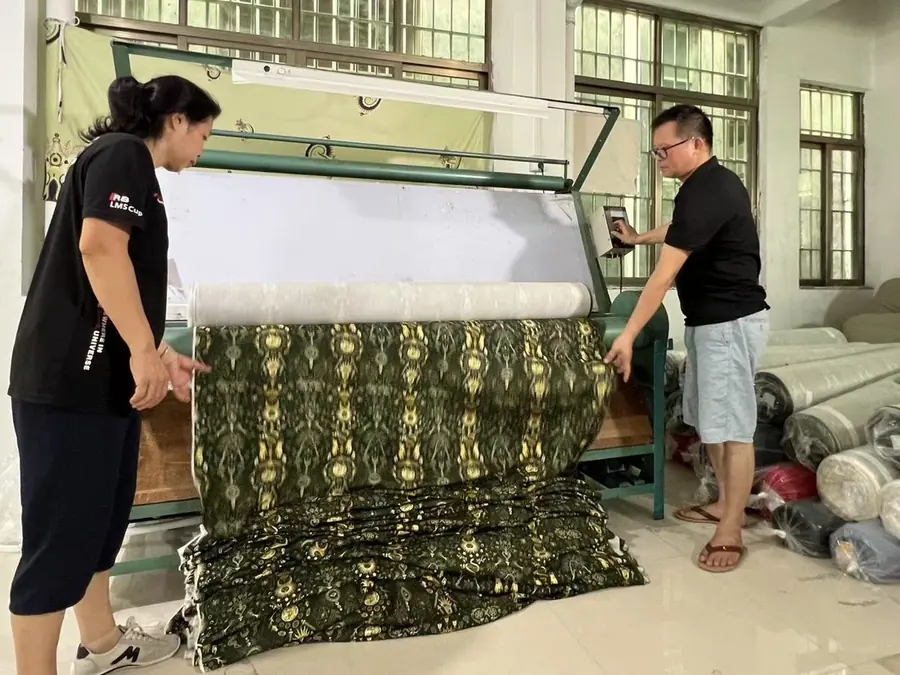
Two fabrics can carry the same fibre-content description and still produce different fit, drape, coverage, sewing behaviour, and return risk.
Use fibre content as identification, not the full brief
Fibre composition matters for product claims, care decisions, and market labelling. In the United States, for example, the FTC Textile Fiber Rule requires covered products to disclose generic fibre names and percentages by weight. That information tells a buyer what the material contains.
It does not tell a factory whether the approved fabric is single jersey, interlock, rib, or another construction. Nor does it define surface finish, stretch direction, weight, opacity, or dimensional change. A compliant label and a production specification solve different problems. If the material direction is still open, use the separate loungewear fabric selection guide before locking the specification.
Record knit construction and fabric weight together
Construction changes how a fabric hangs, recovers, curls at the edge, and behaves during cutting and sewing. Two fabrics at a similar weight can feel and perform differently because the yarn, knit structure, finishing, and stretch are different.
Record the approved construction, finished width, and fabric mass per unit area, normally communicated as GSM. Also agree a practical tolerance and the measurement method. ASTM D3776/D3776M covers methods for measuring fabric mass per unit area; a supplier’s informal weight description is not a substitute for a shared test basis when weight is critical.
Approve the fabric in the garment, not only on the swatch card
A small swatch cannot show how a pale colour behaves when stretched over the body, whether a waistband recovers after sitting, or whether a soft knit becomes too clingy in the intended fit. Review stretch and recovery in the relevant directions, opacity at realistic extension, drape, and surface appearance on a sample garment.
Avoid vague comments such as “more premium” or “slightly thicker.” State the observed problem and the required result: better recovery at the knee, less transparency, a drier hand feel, or a more stable neckline.
Keep colour and finish tied to an approved reference
Brushing, peaching, enzyme treatment, compacting, and print processes can change hand feel and appearance even when the base composition is unchanged. Record the approved finish and use a dated physical swatch or sample as the visual and tactile reference.
For dyed or printed fabric, identify which stage needs approval before bulk cutting. Keep the approval connected to the purchase order and fabric lot so a repeat order does not rely on a colour name such as “dusty pink” alone.
Define the wash method before setting a dimensional-change tolerance
Shrinkage or growth only becomes comparable when the washing, drying, conditioning, marking, and measuring approach is agreed. ISO 3759 describes preparation, marking, and measurement for dimensional-change testing, while the treatment procedure is specified separately.
For a commercial order, write down the care method used for approval, the measurement points, and the accepted result. Test the finished garment when seams, elastic, and trims may affect behaviour differently from the fabric alone.
Keep one fabric approval record that can survive a repeat order
A useful record does not need to be long. It needs to distinguish the approved material from similar alternatives and show which items are still open.
- Generic fibre names and percentages
- Knit or woven construction and yarn details where relevant
- Finished width, GSM, and agreed tolerances
- Stretch direction, recovery, opacity, drape, and surface finish
- Approved colour or print reference and approval date
- Wash method, dimensional-change result, and garment test notes
- Physical swatch or approved sample linked to the order
This record gives the buyer and factory a practical reference for quotation, bulk inspection, and replenishment. It does not remove normal lot variation, but it makes differences visible before they become a finished-garment problem. Use it together with the sample approval checklist before production.